Elements of an articulated chain
Chain
All articulated chains are made up of inner and outer links.
The attached image shows both links with their components. The configuration and construction system of the components are different for the different types of chain.
All the parts of the chain are manufactured with different materials, but mainly based on high quality steels and with different heat treatments.
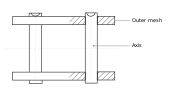
2 pieces of each = 1 outer link
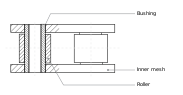
2 pieces of each = 1 inner link
Axes
Shafts are subjected to bending and shear stresses and therefore alloyed cementation steels are generally used in their construction, thus obtaining good core toughness and high surface wear resistance.
Thanks to its perfect finishing grind, an adequate articulation and a precise adjustment are achieved.
Rollers
The rollers are mainly subjected to impact stress and for this reason they are built with tempered steel.
In the case of thick-walled rollers, hardening steels and other materials are used. The correct tolerances allow an impeccable fit on the bushing.
Bushings
Bushings are subjected to bending and crushing stresses and are generally made of case-hardened alloy steels. By means of an adequate heat treatment, the precise resistances and surface quality are achieved.
Meshes
The meshes are subjected to tensile stress and are built with heat-treatable steel.
Depending on the type of chain, a heat treatment is carried out in order to achieve a high resistance to breakage and fatigue, while maintaining good elasticity. The quality of the tooling makes it possible to achieve accuracy in the passage of the chain and the perfect finish of the holes.
What to know about chains
The use of chain transmissions is recommended in any installation and especially in those where the use of belt or gear transmissions is difficult.
The chain transmission combines the advantages of the others and does not present, on the other hand, its drawbacks. Chain transmissions are capable of transmitting any power, with great precision and with a performance of 98%, they cover large distances between axes without problems and even allow movement to be transmitted to several axes at the same time. Roller chains, with their great lightness, have a wide field of application; Its main advantage over sprocket or gear drives is the fact that the center distance of a chain drive is completely independent of the gear ratio.
In general, the breaking load and the pressure on the joints are the main data to take into account for the calculation of a chain, however, due to its multiple applications, different safety factors are taken into account.
The life of a chain does not depend, then, only on the breaking load, but also on the resistance to wear of the articulation elements. The technical study of a chain and its dimensions must be calculated in such a way that there is never breakage of elements, but always before wear of the articulation elements. This wear leads to an elongation of the pitch and naturally causes a faulty mesh. Elongation due to wear should not exceed 3%.
The service life of a chain is then a function, mainly, of its correct dimensioning, taking into account its working conditions, the quality of the installation and the existence of careful and correct maintenance.
After assembly and verification, all chains are lubricated by immersion in a suitable oil bath, so they are supplied with correct lubrication. However, it is advisable to adapt the lubrication to the speed of the chain. We recommend the qualities SAE-40 to 60 and the following ways of greasing:
| V (m/s) | Shape | Nº |
|---|---|---|
| ≤ 2 | Engrase manual cada cierto tiempo con pincel o aceitera | 1 |
| ≤ 8 | Engrase contínuo por goteo | 2 |
| ≤ 14 | Engrase por inmersión o nebulización en cárter | 3 |
| ≥ 14 | Engrase a presión, por circulación forzada, en caso necesario con refrigeración. | 4 |
The lubrication, with oil or grease, must be carried out in the return section, near its next gear and in the separation between internal and external links. Periodic cleaning of the chain and the removal of ferrous particles and other impurities considerably increases its life. In addition to the indicated lubricants, dry-type ones are also used in many cases.
In general, this type of greasing is done before assembling the chain, in its elements and is applied by brush or spray.
Upon receipt, the materials for the construction of chains and wheels are subjected to rigorous control. During its manufacture, continuous verifications of the different pieces are carried out, to verify measurements and tolerances, hardnesses achieved with the different heat treatments and surface qualities. After riveting and before lubricating, the chain is measured in length, under measuring load. The admissible longitudinal difference, in a section of 49 steps, must not exceed 0.15%, in roller chains according to DIN 8187.
Finally, the appropriate dynamic and static tests are carried out.
They are generally joined by connecting links. It is advisable to use chains with an even number of links, which allows the chain to end on both sides in an inner link, and can be joined with a straight joint No. 1 O (the closing clip must always be placed in the direction of travel of the chain). Chains with an odd number of links require the use of elbow joints, which influence the breaking loads of the chains, which decrease by 20%. If the chain is cut, care must be taken not to reuse the excess outer link. The chain wheels must necessarily be well aligned and perfectly fixed on their axis. Parallelism between axes must also be ensured and that their position is correct. An inclination of 60° with respect to the horizontal is the most suitable. The vertically arranged axes imply a constant tensioning of the chain to prevent the chain from losing its teeth on the lower wheel.
The deflection of the return section must not be greater than 2% of the distance between axles and must be reduced to a minimum in impulsive transmissions. The tension must be adjusted by displacement of an axis or by variation of the tensioner. Exaggerated tensioning must be avoided, which would mean, in addition to increasing the stress on the shafts, premature wear and noisy operation. The tensioner must have a travel of at least 1.5 times the pitch of the chain, which allows, if necessary, the removal of two links. Chain drives do not require prior tensioning.
The correct construction of the wheels and the accuracy of their teeth are decisive for the duration of a chain. Drive sprockets with a minimum of 19 teeth are generally used. For tension sprockets and support wheels, it is advisable to use a number of teeth of no less than 13. In transmissions with high speeds or impulsive transmissions, it is advisable, to avoid rapid wear, to use wheels with the toothed area subjected to a suitable heat treatment. It is convenient that the transmission ratio is not higher than 1:8. The number of teeth of the wheels must be adjusted with the number of steps of the chain to avoid that the teeth, in each revolution, come into contact with the same links of the chain.
In cases of conveyor chains with large pitches and slow speeds, wheels with 6 teeth can be used.